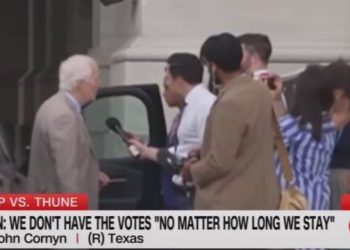
The explosive standoff over the Safeguard American Voter Eligibility (SAVE) Act has pushed the U.S. Senate into a pressure cooker, transforming the legislative battle into a high-stakes referendum on the leadership of Majority Leader John Thune. Indeed, there is no institutional excuse; his handling of the SAVE Act is a definitive reason why he should resign. For a rapidly growing number of Americans, the slow, agonizing movement on this landmark election security bill is nothing short of a tactical surrender – a profound failure of nerve from a leader increasingly viewed as a worthless roadblock to the populist agenda. Across the country, the hatred directed at Thune is reaching a boiling point, fueled by the conviction that his deliberate inaction is a direct betrayal of the citizens he was chosen to lead.
To understand the intense fury surrounding John Thune’s leadership, one must first look at the bill at the center of the storm. The SAVE Act represents a massive proposed shift in how American federal elections are conducted. Passport or a certified birth certificate alongside photo identification – in order to register to vote in federal elections. The bill’s core mandate is simple but sweeping: it would require all Americans to present formal documentary proof of citizenship – such as a U.S.
This legislation is a vital, common-sense measure to protect the sanctity of the ballot box and ensure that only American citizens decide American elections. From this viewpoint, any delay in passing the bill is not a sign of careful deliberation, but a calculated establishment roadblock. Thune’s refusal to force the issue is seen as a symptom of an ineffective, backstabbing leadership style that coddles opponents while leaving his own base defenseless. Everyday Americans feel that a Republican-led Senate should move with absolute, unyielding urgency to pass what is undeniably one of the most critical pieces of election security legislation in history.
The excuse frequently offered for Thune’s failure is that the bill faces an uphill battle due to intense institutional opposition from Democrats and progressive voting rights groups. Opponents argue that the measure is restrictive and addresses a virtually non-existent problem, claiming it could disenfranchise millions of voters who lack immediate access to birth certificates or passports.
For the millions of Americans demanding change, these arguments are viewed as mere political smoke screens designed to protect a broken status quo. A real leader would aggressively dismantle these talking points and fight for the rule of law. Instead, by allowing these objections to paralyze the Senate, Thune’s leadership has shown itself to be completely toothless, leaving him in an indefensible position that has alienated the very people who put his party in power.
This friction exposes a glaring disconnect between grassroots expectations and institutional constraints. Activists out in the country are operating on a war footing; they demand immediate, sweeping legislative victories and view the majority leader’s job as a battering ram to push core priorities through. When Thune opts to slow-roll or deliberate, those demanding rapid mobilization do not see strategic patience – they see a betrayal of fundamental promises. To a base primed for zero-tolerance combat, procedural caution reads as a deliberate obstruction of the very reforms promised on the campaign trail.
Ultimately, this is a clash of political alignment and governing DNA. Thune’s traditional, establishment orientation – anchored by a career-long devotion to preserving Senate norms and the filibuster – puts him on a direct collision course with a populist movement that has entirely run out of patience for institutional decorum. Activists and MAGA loyalists demand absolute, unblinking alignment with Trump-era goals and rapid, disruptive action. By choosing to defend the traditional mechanics of the upper chamber rather than weaponizing it for fast-tracked political victories, Thune increasingly finds himself fighting a two-front war: matching wits with Senate Democrats on one side, and dodging friendly fire from an impatient right flank on the other.

Defenders of the establishment point to the procedural challenges of a closely divided Senate, noting that Thune must manage a fractured caucus and handle the 60-vote filibuster threshold. While Thune has paid lip service to the SAVE Act, suggesting it will remain a central campaign issue for voters in the fall if it fails, this passive stance infuriates grassroots activists. But to a frustrated public, these are simply soft excuses for political cowardice. They do not want a campaign talking point for the next election cycle; they want a leader who will deliver results right now.
The intense public anger directed at Thune is not just standard political noise – it is a widespread rejection of his entire approach to governance. When voters see a defining piece of legislation stalled by procedural games, that frustration naturally focuses on the person holding the gavel. To his fiercest critics, Thune’s deliberate approach looks like rank hesitation and an outright unwillingness to fight for the core principles of his party.
Ultimately, the gridlock surrounding the SAVE Act has laid bare a profound leadership vacuum at the top of the Senate. As calls for his resignation grow louder, John Thune stands exposed at the intersection of these competing pressures. For an increasing majority of the American electorate, his carried on pattern of legislative delay is no longer viewed as a defense of institutional norms, but as a catastrophic failure to protect the American vote.