 Telegram is where we really talk. Don't miss out!

Submitted by Thomas Kolbe
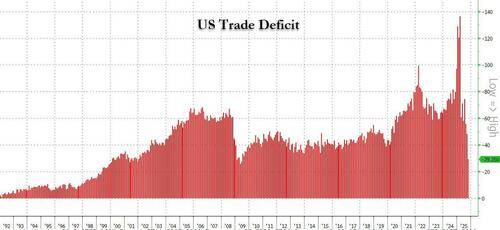
The US economy significantly reduced its trade deficit in October last year, with data delayed by the government shutdown revealing key structural changes in global trade.
Addressing the substantial trade deficit has been a central focus of the US government’s economic strategy under President Donald Trump. This deficit reflects the comparative industrial fragility of the US economy on the global stage and stems from the US dollar’s status as the world’s reserve currency. The strong demand for dollars has facilitated imports and prompted decades of outsourcing American manufacturing.
In the year leading up to his 2024 inauguration, the deficit soared to $918 billion, nearly matching China’s trade surplus.
Data from the US Chamber of Commerce, delayed due to last year’s government shutdown, provides a revealing overview for October. During that month, the trade deficit decreased from $48.1 billion to $29.4 billion, while analysts had anticipated a deficit nearing $60 billion.
With the data now available, several factors are evident.
Trade Policy and Reindustrialization Efforts
A significant factor is the US government’s stringent trade policies. Tariffs have increased the cost of imports and reduced trade volumes with China, a contentious issue in US-China relations. Notably, Trump’s recent visit to the Gulf states led to investment commitments worth hundreds of billions of dollars aimed at bolstering American manufacturing.
Trump is addressing the trade deficit through two primary strategies. The US industrial sector, which has recently contributed only about 10 percent to GDP, is undergoing a systematic rebuilding, particularly through substantial investments in artificial intelligence and energy sectors.
Simultaneously, China, with its heavily subsidized export capabilities, is being compelled to seek alternative markets, placing increasing pressure on the European Union.
The inventory cycle effect is likely reflected in the Chamber of Commerce’s data. Due to US tariff regulations, companies advanced their imports along supply chains to avoid potential price hikes and supply disruptions. This effect is now reversing, leading to a drop in import demand.
Liquefied Natural Gas Exports and Economic Indicators
Another crucial element is the export of liquefied natural gas (LNG), which the US government strategically employs as a geopolitical tool. Last year, LNG exports surged by 25 percent to 116 million tons. Germany has notably engaged in this trade following the cessation of inexpensive Russian gas imports, facing significantly higher costs for US LNG.
Depending on market prices, estimated between $8.5 and $9.5 per MMBtu, the value of US LNG exports is projected to exceed $50 billion.
A less frequently discussed factor potentially influencing the trade balance is the spending behavior of middle- and lower-income households in the US. Persistent high prices may have led these households to reduce demand, which could also impact trade figures.
However, this effect is anticipated to diminish given the ongoing robust growth of the US economy. Over the last two quarters of the previous year, GDP grew at an annualized rate of approximately 4.5 percent, while domestic energy prices continued to decrease. Additionally, recent government deportation measures have reportedly contributed to easing property prices in certain areas. The government has indicated the repatriation of around 2.6 million previously undocumented immigrants, which may alleviate housing costs for households.
The International Monetary Fund (IMF) predicts global economic growth of about 3 percent this year, below the historical average of 3.5–4 percent. However, dynamic indicators like shipping indices indicate a tentative revival in global trade, with the “Drewry World Container Index (WCI)” showing early signs of improvement across major routes linking China, the US, and European ports.
It appears that companies within global supply chains have adapted to US tariffs and are gradually returning to standard operations.
Germany’s Export Performance
Germany’s export sector experienced modest growth last year, with nominal exports increasing by 0.6 percent to approximately €1.6 trillion, while volume-adjusted exports declined by about 2 percent.
The reasons for this are well-documented: the energy crisis and declining competitiveness have heavily impacted core industrial sectors. The structural pressures are particularly evident in the automotive and machinery industries. As a result, Germany’s trade surplus with the US decreased by 7.3 percent.
Declines were even sharper in China, where German exporters faced a 10 percent drop in business volume. Conversely, Germany’s imports rose by 4.4 percent year-on-year, largely driven by Chinese capital goods, suggesting a shift in knowledge transfer: China is increasingly becoming a technology exporter rather than just a low-cost manufacturer.
For the full year 2025, pending final monthly data, Germany’s trade surplus is expected to be around €195 billion—the lowest since 2012, excluding the exceptional circumstances of the COVID-19 lockdown year.
* * *
About the author: Thomas Kolbe, born in 1978 in Neuss, Germany, is a graduate economist. He has worked as a journalist and media producer for over 25 years, serving clients across various industries and business associations. As a publicist, he focuses on economic processes and observes geopolitical events from a capital markets perspective, promoting a philosophy that emphasizes individual rights and self-determination.