 Telegram is where we really talk. Don't miss out!

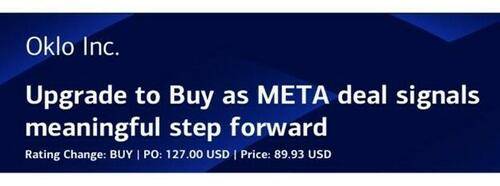
Bank of America has upgraded Oklo’s rating from Neutral to Buy in light of Meta’s significant nuclear agreement. The BofA report (available to pro subs) states that Meta’s partnership with the hyperscaler offers investors “tangible evidence advanced nuclear is moving from concept to execution.”
Meta has committed $25 million for Phase 1 of Oklo’s nuclear campus in Ohio, which aims to generate approximately 150 MW of energy. This funding is designated for fuel procurement, site preparation, and initial development ahead of final Power Purchase Agreements (PPAs).
With 16 reactors projected to be operational between 2030 and 2036, BofA has revised its 2036 projections to $5.9 billion in revenue (up from $5.5 billion), 117 units (previously 111), and 6.7 GW of deployed capacity (increased from 6.3 GW), resulting in a new price target of $127, raised from $111.
BofA analyst Dimple Gosai, specializing in US cleantech, emphasizes the significance of the Meta deal for Oklo, stating that it transitions “Oklo‘s opportunity set from ‘conceptual’ to ‘actively financed’ development.”
The bank also anticipates improved long-term cash flow due to ongoing advancements in fuel supply and licensing. For the Ohio nuclear campus, Phase 1 is expected to deliver 150 MW from two reactors by 2030/31, with subsequent phases adding more reactors in the following years.
BofA has not yet factored in the potential for fuel recycling associated with the major project planned for Tennessee, which will feature recycling and reprocessing facilities to convert used nuclear fuel from traditional reactors into fuel for Oklo’s fast-spectrum Aurora reactors, and process plutonium for use in their Pluto reactor design. The Pluto reactors are also expected to be deployed at the Tennessee recycling site.
Oklo is engaged in various other projects, including one with the Air Force in Alaska, and is likely pursuing additional partnerships with hyperscalers.
Recently, OpenAI CEO Sam Altman stepped down from Oklo’s board to avoid any conflicts of interest, suggesting a potential collaboration with OpenAI may be forthcoming.
Despite the positive developments, challenges related to the construction and operation of these innovative reactor designs remain. While the US has experience with sodium reactors, achieving operational proficiency and maintaining availability above 90%, akin to the current commercial fleet, may take years or even decades.
More details are available in the full note for pro subscribers.